This afternoon when I casted my vote, it was for the winning candidate and I can say I am happy about that! My polling place only had a short line when I went to vote, but I voted around 10:30AM. I was taking a break from my massive stack of journal articles I have been reading. I have a first draft of a paper in my advanced volcanology class due in a little over a week. Luckily my topic is about some work I have completed so far for my masters thesis. That is were the luck stops, because I have some sections of the paper completed, but other sections need to be vastly improved, so that's were the big stack of papers rears its ugly head! All of the papers I have read in the last three days are on magma mixing and enclaves. I still probably have several more days of reading with a equally large stack of crystal size distribution papers to get through. So I am defiantly going to be busy the next week or so, woohoo!
Here is a sampling of some of the papers I have read. My list could be much longer, but I don't want to bore you.
Bacon, C.R., 1986, Magmatic Inclusions in Silicic and Intermediate Volcanic Rocks: Journal of Geophysical Research, v. 91, p. 6091-6112.
Browne, B.L., J.C. Eichelberger, L.A. Patino, T.A. Vogel, J. Dehn., K. Uto, and H. Hoshizumi, 2006, Generation of Porphyritic and Equigranular Mafic Enclaves during Magma Recharge Events at Unzen Volcano, Japan: Journal of Petrology, v. 47, p. 301-38.
Eichelberger, J.C., 1980, Vesiculation of mafic magma during replenishment of silicic magma reservoirs: Nature, v. 288, p. 446-450.
Koyaguchi, T., 1985, Magma mixing in a conduit: Journal of Volcanology and Geothermal Research, v 25, p. 365-369.
Martin, V.M, D.M. Pyle, and M.B. Holness, 2006, The role of crystal frameworks in the preservation of Enclaves during magma mixing: Earth and Planetary Science Letters, v. 248, p. 787-799.
Sparks, R.S.J., H. Sigurdsson, and L. Wilson, 1977, Magma mixing-a mechanism for triggering acid explosive eruptions: Nature, v. 267, p. 315-318.
Showing posts with label enclaves. Show all posts
Showing posts with label enclaves. Show all posts
Tuesday, November 4, 2008

Tuesday, September 9, 2008
Field work

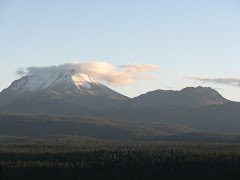
It has actually been awhile since I last posted a blog and I finally got to my field area. The above picture is after eating lunch in Anderson, CA at a Panda Express. I was laughing at the view, not many fast food joints have such a great view, so I figured the picture was a great way to start out the trip! If you want to know where Lassen Peak is look above my head. I was hoping that Lassen was not going to be busy and it wasn't. The weather was beautiful and the sky a wonderful blue color. So we set up camp and embarked on my reconnaissance trip of my field area.


So when we got there Wednesday afternoon, we didn't really have a plan, so we decided since I had not hiked the Chaos Jumbles in detail, that is what we would do first. A refresher, in case you forgot from previous posts, the Chaos Crags are six dacitic domes, named A-F, with Dome A, the oldest in age. The Chaos Jumbles were the result when Dome C collapsed somewhere around 300 years ago (Heiken and Eichelberger, 1980). For my field work, I am trying to figure out the magma mixing event or events. To do so, I need to look at the enclaves (blobs in the rock not of host origin) and distinguish if there are different types. So far there seems to be three different types present in each of the six domes, but I believe that there might be more variations. I think I will be able to determine this with more field work and Crystal Size Distributions (CSD).
 The above picture is a fine-grained porphyritic enclave in the host dacite, as classified by Heiken and Eichelberger, 1980. The enclave is about 1 ft long, the larger crystals are resorbed plagioclase from the host dacite.
 This is a medium grained porphyritic enclave also in the dacite host and once again the larger crystals are resorbed plagioclase. This enclave was smaller at around 8 in.
Heiken, G., and J.C. Eichelberger, 1980, Eruptions at Chaos Crags, Lassen Volcanic National Park, California; Journal of Volcanology and Geothermal Research, 7, 443-481.
There is still more from the first day, but you have to wait until the next post.
Sunday, July 13, 2008
Getting to know me- My thesis project
 In Fall 2007, I was lucky enough to get an aerial view of my field area by hiking to the top of Lassen Peak. Keep in mind, I was on a geology field trip, where I only had two hours of free time to climb over 2,000ft and get back down. I was only 15 min. late and I can say I ran down Lassen Peak, down in about 35 min.
So my project is the Chaos Crags, located north of Lassen Peak. The crags consist of 6 rhyolitic domes that contain basaltic-andestic enclaves (which are blobs of a different type rock within the host rock). I will soon be spending many hours (that is, if the smoke from all of the fires clears) point counting these enclaves, looking for different types, size, etc. In the meantime, I am also taking digital pictures within thin-sections of these volcanic rocks and using a method called CSD distribution on plagioclase. I am old school, actually outlining plagioclase crystals within each picture using a lightbox and tracing paper, lets just say my hand and wrist hurts and I should buy stock in Sharpie pens. But I am not complaining because I can do this at home, whenever I feel like it, and it gets me more familiar with the rocks, only if my son was older, he could help me trace and color. I have tried using the computer, but I have to admit that I am not advanced enough to use a program like photoshop CS3 to outline just plagioclase crystals.
Subscribe to:
Posts (Atom)